5 Ways Smart Home Security Can Lower Your Insurance Premiums
A smart home security system can lower your insurance premiums, but only when the devices are on your insurer's approved list and you can document the installation. Discounts are set by each carrier and vary by device type and monitoring requirements. Confirm the exact credit in writing before buying equipment.
Last Updated: November 7, 2026
Quick Summary
- Discounts are set by each insurer, not by a national standard
- Many insurers give larger discounts for professionally monitored systems
- Confirm device eligibility and documentation requirements with your insurer in writing
- Compare the discount against equipment costs and monthly monitoring fees
- Ask whether a discount applies at renewal, since mid-term installs may not change premiums immediately
Table of Contents
- How Insurance Discounts for Security Systems Work
- Monitored Versus Unmonitored Systems: Which Qualifies for Larger Savings
- Ring and Other Smart Devices: Do They Count for Insurance Discounts?
- Smoke and Water Leak Detectors: Discounts Beyond Burglary Protection
- Break-Even Math: Device Costs, Monitoring Fees, and Realistic Premium Savings
- Verifying a Discount Before You Buy or Install
- Your Next Step: Asking Your Insurer About Eligible Smart Security Upgrades
- Frequently Asked Questions
Homeowners who ask whether a smart home security system can lower their insurance bill are asking a practical question. The short answer is that it can, but only when the right devices are installed, documented, and reported to the insurer. Homeowners across the Chicagoland area often weigh this decision before they invest in equipment, and the most useful starting point is understanding how insurers actually evaluate risk reduction.
Insurers set premiums based on how likely a claim is and how expensive that claim would be. A home with an alarm, cameras, or water sensors presents lower risk on paper. Many insurers reflect that lower risk through discounts, though the size and availability of each discount vary by company and by state.
Here is what matters most before you spend money:
- Discounts are set by each insurer, not by a national standard
- Eligibility usually depends on specific device types and proof of installation
- Monitoring requirements differ from one carrier to the next
- A discount only helps if the savings exceed your equipment and fee costs
We will walk through each of these points so you can make a decision based on your own policy.
How Insurance Discounts for Security Systems Work
An insurance discount for a security system is a reduction in your annual premium tied to a specific protective feature. Some insurers offer discounts for burglar alarms, fire alarms, and sometimes automatic sprinklers or water shutoff devices.
Most carriers follow a similar process:
- You disclose the devices in your home on your application or at renewal
- The insurer checks the equipment type against its approved list
- Some insurers ask for an installation certificate or a copy of the monitoring contract
- The discount appears on your policy, often at the next renewal date
Ask your agent in writing which devices qualify and what documentation you will need to keep on file.
Monitored Versus Unmonitored Systems: Which Qualifies for Larger Savings
A monitored system sends alerts to a professional monitoring center that can dispatch police or fire responders. An unmonitored system sounds an alarm locally or sends notifications to your phone without a live response team.
Many insurers give larger discounts for monitored systems because a response team can reduce the damage from a break-in or fire. Some carriers still offer smaller credits for self-monitored setups, but the terms differ. Review what your insurer counts as monitoring before you choose a service plan.
Ring and Other Smart Devices: Do They Count for Insurance Discounts?
Video doorbells, indoor and outdoor cameras, and smart locks are among the devices homeowners ask about, and treatment varies by carrier. Before choosing equipment, you can review how to plan a residential smart security system so the devices you buy fit your home's entry points and wiring. The reason is structural: insurers build discounts around verified risk reduction, and a standalone consumer device that a homeowner installs and monitors on a phone is harder to verify than a professionally installed and monitored system.
A useful way to think about it is by device category and what the insurer can verify:
- Video doorbells and standalone cameras: Some carriers count them only when they are integrated into a monitored system or when footage is retained in a way the insurer accepts. Others ignore standalone consumer devices entirely for premium credits, though they may still be viewed favorably at underwriting. Confirm the specific model and integration, not just the brand.
- Smart locks: Rarely a standalone discount item. They may count as part of a broader smart-home package or a monitored system, but a lock by itself is usually not an approved credit device.
- Professionally monitored alarm panels: The most commonly credited device category, because the monitoring center and dispatch record give the insurer something to verify.
- Water-leak sensors and automatic shutoff valves: Increasingly credited because water damage is a frequent and expensive claim, and shutoff valves can stop damage automatically.
- Smoke, heat, and carbon monoxide detectors: Often credited, sometimes as a separate line item from burglary protection.
Before you assume a device qualifies, confirm four things with your insurer in writing:
- The specific device model or system is on the insurer's approved list
- Whether professional monitoring is required, and what counts as monitoring
- Whether the device must be professionally installed or can be self-installed
- What proof the insurer needs, an installation certificate, a monitoring contract, or a receipt
Discounts may follow the monitoring contract rather than the hardware, and the terms differ enough across carriers that you should not assume parity between companies.
Watch out: buying devices first and asking the insurer later can leave you paying for equipment that earns no credit. A device that is not on the approved list, or a system that does not meet the monitoring requirement, can leave you paying for equipment that earns no credit.
If you want a device to do double duty, prioritize categories that address both security and property damage, monitored alarms, water-leak sensors with automatic shutoff, and smoke/heat detectors, because those are the categories most consistently tied to credits. Insurance Information Institute home security and insurance resources
Smoke and Water Leak Detectors: Discounts Beyond Burglary Protection
Insurance discounts are not limited to burglary. Smoke detectors, heat sensors, and water leak detectors can reduce premiums because they catch problems that cause expensive property damage. Water damage is one of the most common homeowner claims, so leak sensors and automatic shutoff valves often qualify for credits.
Smart leak sensors that send phone alerts can prevent damage before it spreads. Ask your insurer whether these devices qualify alongside alarm systems, since some carriers apply the discounts separately.
Break-Even Math: Device Costs, Monitoring Fees, and Realistic Premium Savings
Most articles stop at "you might get a discount." The decision that actually matters is whether the discount exceeds what you pay for equipment and monitoring over the years you plan to keep the system. Run the math before you buy, not after.
The formula is straightforward:
Annual net savings = Annual premium discount − (Monthly monitoring fee × 12) − (Equipment cost ÷ Years of expected use)
What makes the formula useful is plugging in realistic ranges rather than guesses. A common pattern in the market is:
- Equipment: Equipment costs depend on the devices chosen, the number of sensors, and whether wiring is required, so request a written quote for your home.
- Monitoring: Monitoring fees vary by provider and plan, so pricing depends on your service agreement and should be confirmed in a written quote.
- Premium discount: Some carriers cap the total credit or apply it only to certain coverage parts, so confirm the exact discount with your insurer in writing.
The break-even formula above lets you test your own numbers: substitute the discount your insurer confirms, your actual monitoring fee, and your equipment quote.
Watch out: discount caps and renewal timing can erase a positive result. If your insurer applies the credit only at renewal, a mid-term installation may not change your premium for months, and if the credit is capped at a flat dollar amount, a higher premium does not produce a proportionally higher discount.
Two practical refinements improve the estimate. First, ask your insurer whether the credit applies to the whole premium or only to specific coverage parts, because that changes the dollar amount. Second, treat equipment as a sunk cost after the first year and compare the ongoing monitoring fee against the ongoing discount, if the discount is smaller than the monthly fee, the system will not pay for itself through insurance alone.
Get written quotes from both your insurer and your security provider before running the calculation, since pricing depends on equipment, service plan, and your policy. NAIC homeowner insurance consumer resources
Before buying, compare what you would pay for equipment and monitoring against the discount you would actually receive.
| Cost or check | What to look at | Why it matters |
|---|---|---|
| Equipment cost | Written quote for your home | Depends on devices and wiring |
| Monitoring fee | Monthly fee in your service agreement | Recurring cost that offsets the discount |
| Premium discount | Exact amount confirmed by your insurer | Varies by carrier and may be capped |
| Discount timing | Whether credit applies at renewal | A mid-term install may not change premium yet |
| Coverage scope | Whether credit applies to the full premium or specific parts | Changes the dollar value of the credit |
Verifying a Discount Before You Buy or Install
Verifying a discount before you buy or install can save time and money. Follow these steps:
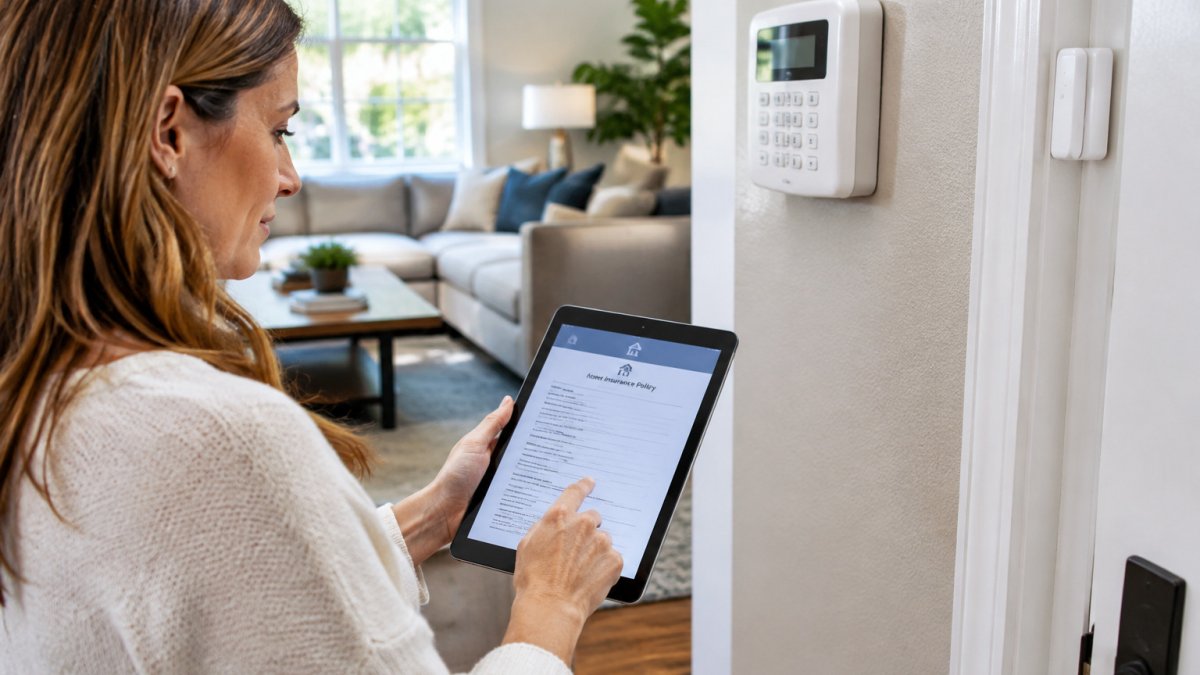
- Ask your insurer in writing which devices qualify
- Request the exact discount percentage or dollar amount
- Confirm whether monitoring is required
- Ask what proof of installation the insurer needs
- Keep receipts, installation records, and monitoring contracts on file
A common mistake is installing equipment first and asking the insurer later. Verify the rules first so you do not pay for devices that earn no credit.
Watch out: some insurers only apply a discount at renewal, so a mid-term installation may not change your premium until the next billing cycle.
Your Next Step: Asking Your Insurer About Eligible Smart Security Upgrades
The clearest next step is a direct conversation with your insurance agent. Bring a list of the devices you plan to install and ask which ones qualify for a discount, how much the discount would be, and what documentation you need.
Once you have those answers, compare them against the cost of equipment and monitoring. If you want help planning a residential smart security system, For current pricing or a quote on a residential smart security system, visit the Dalcorp Solutions website.
Frequently Asked Questions
Does having a home security system reduce homeowners insurance?
It can. Many insurers offer a discount for an approved security system, but the discount is set by each company and is not automatic. Eligibility usually depends on the type of system, whether it is monitored, and whether the insurer needs proof of installation such as a certificate or invoice. Discounts commonly fall in a modest range, so the net savings depend on your premium and the cost of the equipment and any monitoring fee. Ask your insurer which specific devices and monitoring levels qualify before you buy.
Does Ring count as a security system for insurance?
Sometimes. Ring cameras, doorbells, and alarm equipment may qualify under some insurers' programs, but many policies only recognize systems that meet defined criteria, such as professional monitoring or specific sensor types. Whether a Ring setup counts depends on your insurer's rules and how the system is configured. Contact your agent with the exact model numbers and ask them to confirm eligibility in writing before you rely on the discount.
Do monitored security systems qualify for larger insurance discounts?
Monitored systems often qualify for larger discounts than self-monitored or unmonitored setups because a monitoring center can dispatch help when an alarm trips. That added response reduces the likelihood of a loss in many insurers' assessments. The trade-off is the ongoing monitoring fee, which can offset part or all of the premium savings. Compare the annual monitoring cost against the discount your insurer confirms to see whether the net benefit makes sense.
How can I ask my insurer whether my security system qualifies for a discount?
Call your agent or insurer and provide the make, model, and monitoring details of your system. Ask whether the system qualifies, what the discount percentage is, and what documentation they require, such as an installation certificate or monitoring agreement. Request the answer in writing and note the policy effective date. Verifying eligibility before purchase or installation prevents paying for equipment that does not generate a discount.

- Hits: 6