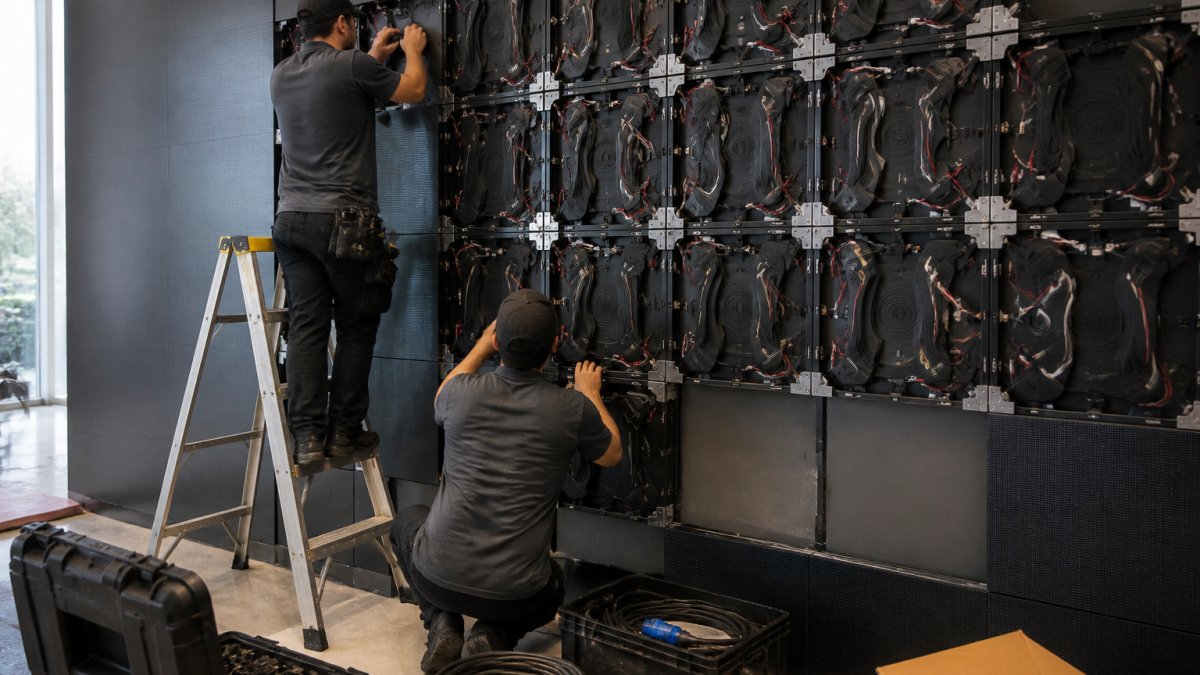
Best LED Video Wall Installation Services in 2026
The best LED video wall installation services combine licensed, factory-certified crews with a documented process from site survey through ongoing support.
Table of Contents
- What Separates the Best LED Video Wall Installation Services
- LED Video Wall Installation Cost: What Drives Your Quote
- The LED Video Wall Installation Process, Step by Step
- LED Video Wall Pixel Pitch: Matching Specs to Your Space
- LED Video Wall Maintenance and Lifecycle Support
- How to Vet an LED Video Wall Installation Company
- Indoor, Outdoor, and Rental LED Display Solutions
- Frequently Asked Questions
Last Updated: October 9, 2026
What Separates the Best LED Video Wall Installation Services
At Dalcorp Solutions Inc, we have spent 25+ years installing low-voltage and display systems across Chicagoland commercial and residential properties, with more than 2,000 projects completed.
Below, we show you how to compare quotes line by line, so you can tell a real turnkey solution from a low bid that omits the expensive parts.
LED Video Wall Installation Cost: What Drives Your Quote
LED video wall installation cost is driven by pixel pitch, screen size, mounting method, and site conditions, not the screen alone.
Published industry guidance puts installed direct-view LED walls in a wide range. According to Crown TV's LED video wall cost guide, outdoor P4-P8 walls installed run roughly $400 to $900 per square foot, while indoor P2.5 walls run roughly $900 to $1,600 per square foot.
Those ranges are starting points, not quotes. Your number depends on your building.
Itemized Cost Drivers
| Cost Driver | What It Covers | Why It Moves the Price |
|---|---|---|
| Screen panels and cabinets | LED modules, power supplies, receiving cards | Pitch and brand set the base material cost |
| Mounting structure | Wall frame, truss, or freestanding support | Load-bearing walls cost less than reinforced structures |
| Electrical work | Dedicated circuits, distribution, breakers | Older buildings often need new service |
| Signal and data | Video processor, cabling, source routing | Distance and source count change hardware needs |
| Installation labor | Crew time, lift equipment, safety | Height and access drive hours |
| Design and engineering | Site survey, drawings, load calculations | Complex venues need more planning |
| Commissioning | Calibration, testing, training | Skipping this shortens panel life |
The LED Video Wall Installation Process, Step by Step
A professional LED video wall installation follows six stages: consultation, site survey, design and engineering, fabrication, on-site installation, and commissioning. Each stage produces documentation you should receive before the next begins.
Total Time: 4-10 weeks depending on wall size and site readiness Difficulty: Not a DIY project; requires licensed trades and trained crews
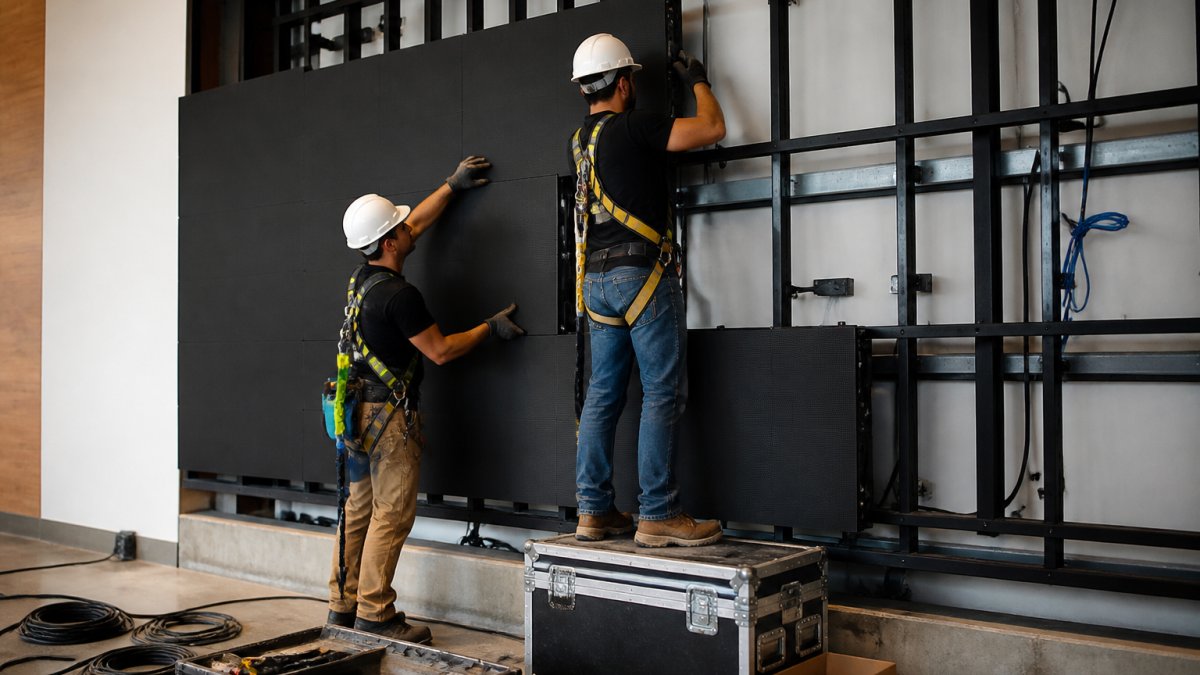
Site Readiness and Permitting
Site readiness is the step buyers underestimate most. Before panels arrive, the wall must support the load, power must reach the mounting location, and the signal path must be planned.
- Project consultation. Define viewing distance, content type, and budget range.
- Site survey. Measure the wall, check structural support, and map power and data routes.
- Design and engineering. Produce mounting drawings and load calculations.
- Permitting. Commercial installations typically require electrical permits and, in some cases, structural review. Requirements vary by jurisdiction, so confirm locally before scheduling.
- Installation. Mount the frame, hang cabinets, run power and signal, then test.
- Commissioning. Calibrate brightness and color, train your staff, and hand over documentation.
As documented in Neoti's LED video wall cost breakdown, installation requires trained professionals because panel alignment, power distribution, and calibration all affect long-term performance.
LED Video Wall Pixel Pitch: Matching Specs to Your Space
LED video wall pixel pitch is the distance in millimeters between the centers of two adjacent pixels. Smaller numbers mean tighter pixels, sharper close-range images, and higher cost.
The practical rule: match pitch to your closest viewer, not your farthest.
| Viewing Distance | Recommended Pitch | Typical Use |
|---|---|---|
| Under 10 feet | P1.2-P1.9 | Boardrooms, lobbies, control rooms |
| 10-20 feet | P2.5-P3.9 | Retail, churches, conference venues |
| 20-40 feet | P4-P6 | Large indoor venues, arenas |
| Over 40 feet | P6-P10 | Outdoor displays, billboards |
Brightness matters just as much. Indoor walls generally run lower nits, while outdoor displays need high brightness to stay readable in direct sun.
LED Video Wall Maintenance and Lifecycle Support
LED video wall maintenance covers three things: spare parts, service response, and calibration over time. Your contract's support terms decide how painful year three feels.
What to confirm before signing:
- Spare modules on hand. Panels fail individually; replacements should match your batch.
- Response time in writing. Ask for a stated window for on-site response, not a verbal promise.
- Remote diagnostics. Many processors report panel health and can flag failures early.
The failure mode is rarely catastrophic: one panel, then another, until the wall looks patchy. Fast access to matching spares separates a well-supported install from an orphaned one.
How to Vet an LED Video Wall Installation Company
Vetting an LED video wall installation company comes down to five checks: licensing, insurance, factory certification, documented process, and references you can call. Run all five before comparing price, two bidders can both answer "yes" and still be worlds apart on capability.
The Five Checks, and What a Strong Answer Looks Like
- Licensing. Ask for the state or local electrical contractor license number, then verify it with the issuing authority rather than accepting a photocopy. A low-voltage or AV license is not the same as an electrical contractor license, and the wall's power side is where unlicensed work becomes a code problem.
- Insurance. Request a certificate of insurance showing current general liability and workers' compensation coverage. If a crew member is injured on a lift at your site, the coverage question lands on you.
- Factory certification. Ask which panel brands the crew is certified on and for the certificate dates. Certification is brand-specific; a crew certified on one manufacturer's cabinets may be learning yours on your dime.
Side-by-Side Installer Comparison
Most buyers compare quotes on total price. A more useful comparison scores each bidder on the criteria that predict year-five performance. Build a simple matrix with one row per bidder and score each column.
| Evaluation Criterion | What to Score | Why It Predicts Long-Term Performance |
|---|---|---|
| Service area and response | Stated on-site response window, in writing | Determines downtime when a panel fails |
| Project types completed | Similar venue size, indoor vs. outdoor, permanent vs. rental | Unfamiliar venue types surface as alignment and calibration problems |
| Installation capability | In-house electrical and structural work vs. subcontracted | Fewer handoffs means fewer finger-pointing delays |
| Engineering deliverables | Load calcs, drawings, as-builts included | Tells you whether engineering is real or a line item |
| Warranty and support | Coverage length, labor included, spare-parts policy | Decides your cost of ownership after year one |
| References | Reachable, similar-scope clients | The only external check on the claims above |
Score each column 1 to 5 and total. A bidder with a slightly higher price but strong scores on engineering, in-house trades, and spare-parts policy is usually the cheaper wall over its life.
Questions That Separate Real Integrators From Resellers
A reseller sells panels and hires out the install. An integrator owns the outcome. These questions surface which one you are talking to:
- Who pulls the electrical permit, and whose license number appears on it?
- Who performs the structural load calculation, and can I see a sample?
- Who trains my staff on the processor and content workflow?
If the answers point to a single accountable company across permitting, engineering, installation, commissioning, and service, you are dealing with an integrator. If they point to three or four entities, you are the general contractor on your own project, fine, as long as you price the time it will cost you.
This is where a holistic integrator earns its premium: a company already handling low-voltage systems, networking, and access control can coordinate power, data, and mounting under one contract instead of leaving you to referee three trades.
Indoor, Outdoor, and Rental LED Display Solutions
Indoor, outdoor, and rental LED display solutions differ mainly in brightness, weather sealing, cabinet weight, and mounting. Choosing the wrong category is one of the most expensive errors in this market, because specs that make a wall excel in one environment make it fail in another.
Indoor Displays
Indoor displays prioritize tight pitch and color accuracy for close viewing, suiting lobbies, retail floors, churches, boardrooms, and control rooms where viewers stand within 20 feet. Brightness runs a few hundred to roughly 1,000 nits, enough for a lit room, not direct sun. Cabinets are lighter and thinner than outdoor equivalents, and pitch commonly runs from P1.2 in boardrooms up to P4 in large indoor venues.
Outdoor Displays
Outdoor displays prioritize brightness and durability. Panels are sealed against rain and dust and built for temperature swings, suiting storefronts, venues, and billboards. Brightness starts well above indoor levels, often several thousand nits, so the image stays readable in direct sun. Weather sealing is rated on the IP scale, commonly IP65 for the front face. Pitch is usually wider because viewers stand farther away, commonly P4 to P10.
Rental Displays
Rental displays prioritize portability. Cabinets are lighter and built for quick assembly and teardown, fitting events, conferences, and temporary activations where the wall moves every few weeks. They typically use quick-lock or curving hardware, ship in road cases, and are engineered for repeated handling rather than permanent mounting. Pitch is often mid range, tight enough for stage viewing distances, wide enough to keep cabinet count and weight manageable.
Choosing Between Them
| Factor | Indoor | Outdoor | Rental |
|---|---|---|---|
| Typical brightness | A few hundred to ~1,000 nits | Several thousand nits | Mid to high, venue-dependent |
| Weather sealing | Not required | IP-rated front and rear | Not required, but ruggedized |
| Cabinet weight | Lightest | Heaviest | Light, quick-lock design |
| Typical pitch | P1.2-P4 | P4-P10 | Mid range |
| Mounting | Wall, recess, freestanding | Structural, pole, wall | Truss, ground support, quick-lock |
| Primary risk if mismatched | Washed out in bright light | Overbuilt and overpriced indoors | Fails under permanent-mount loads |
If your venue hosts both permanent signage and recurring events, you may need two systems rather than one compromise. The most common mismatch is a buyer specifying an outdoor-rated wall for a covered but sunlit atrium, paying the weather-sealing and brightness premium for conditions the wall will never face, or installing an indoor wall behind glass where afternoon sun washes it out by 2 p.m.
As documented in American LED Wall's outdoor display guidance, outdoor screens are built bright enough for full-sun visibility and sealed against rain and dust, which is exactly why they cost more per square foot than an indoor wall of the same pitch.
Frequently Asked Questions
How much does it cost to install an LED video wall?
Published guidance points to installed direct-view LED pricing of roughly $400 to $900 per square foot for outdoor P4-P8 walls, $500 to $900 per square foot for indoor P3 and finer, and $900 to $1,600 per square foot for indoor P2.5. Some budgeting guides cite installation starting around $15,000, while larger MicroLED bundles can exceed $200,000. Your actual quote depends on pixel pitch, wall size, mounting method, and site conditions, so request a project-specific estimate.
How do I choose an LED video wall installation company?
Look for licensed and insured status, factory-certified technicians, and a documented process that starts with a site survey. Ask for completed projects similar to yours, written warranty terms, and a named support contact after handoff. Neoti notes that LED wall installation requires trained professionals, so confirm the crew doing the work is on staff rather than subcontracted. A provider that also handles low-voltage integration can coordinate power, data, and control systems instead of leaving gaps.
What is the difference between an LED video wall and an LCD video wall?
LED video walls use individual light-emitting diode panels that tile together with no visible bezels, so they scale to large sizes and stay bright in direct light. LCD video walls use liquid crystal displays with thin frames, which create visible grid lines between screens. For outdoor displays, full-sun venues, or seamless large-format video, LED is usually the better fit. LCD walls can cost less for smaller indoor installations where some bezel visibility is acceptable.
What maintenance does an LED video wall require?
Routine LED video wall maintenance includes cleaning panels with approved products, checking power and data connections, monitoring for dead pixels, and verifying cooling airflow behind the wall. Most installations need a professional inspection once or twice a year, plus immediate service if a module fails. Front-serviceable panels let technicians replace modules without dismantling the wall, which cuts downtime. Confirm your warranty covers parts, labor, and response time before signing.
Can an LED video wall be installed in an existing building?
Yes, in most cases. The installation process starts with a site survey to check wall structure, power capacity, cable routing, and mounting clearance. Existing buildings often need reinforced mounting points or a new dedicated circuit, but a full rewiring job is rarely required. Providers that handle low-voltage integration can route data and power through existing pathways. Permitting requirements vary by jurisdiction, so confirm who pulls the electrical permit before work begins.
- Hits: 4