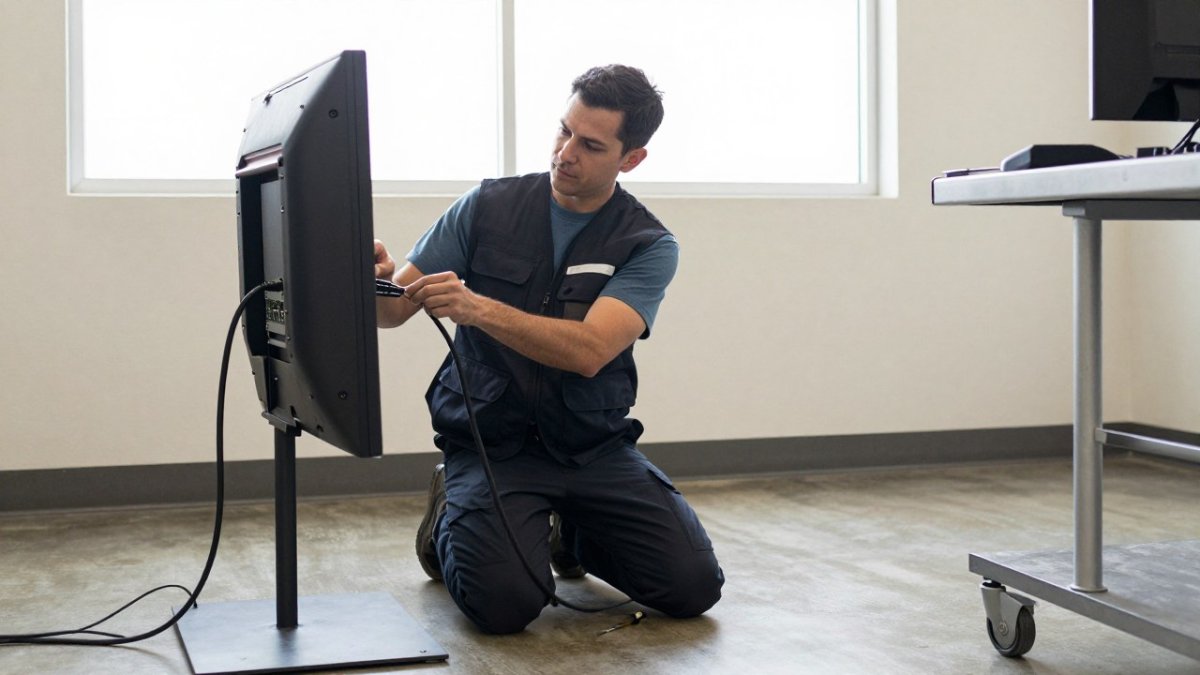
Direct View LED vs LCD Video Walls for Retail Stores
Direct-view LED video walls suit large, bright, seamless storefront displays, while LCD video walls are a lower-cost option for smaller indoor installations. Direct-view LED has no visible seams and stays readable in sunlight, but costs more upfront. Choose based on light conditions, viewing distance and total cost.
Last Updated: November 17, 2026
Quick Summary
- Direct-view LED walls have almost no visible seams because the cabinets lock together.
- LCD walls cost less upfront but show bezel lines between panels.
- Direct-view LED is generally better for storefront walls facing bright windows.
- Match pixel pitch to the distance from which shoppers will view the wall.
- Compare total cost of ownership over five years, including downtime and service.
Table of Contents
- How Direct-View LED and LCD Video Walls Are Built
- Direct-View LED vs LCD: Side-by-Side Comparison
- Retail Brightness and Ambient Light: Storefront and Window Placement
- Pixel Pitch and Viewing Distance for Shopper Sightlines
- Total Cost of Ownership: Direct-View LED vs LCD Video Walls
- Video Wall Maintenance, Lifespan, and Installation Logistics
- Choosing the Right Display for Your Store: Next Steps
- Frequently Asked Questions
How Direct-View LED and LCD Video Walls Are Built
Direct-view LED and LCD video walls both combine many panels into one large display, but they produce light in different ways. A direct-view LED wall places a grid of light-emitting diodes on the surface, and each cluster of diodes acts as a pixel. An LCD video wall places a liquid crystal layer in front of a backlight, and the crystals control how much light passes through. Retail buyers who understand this basic difference can judge the trade-offs in brightness, contrast and upkeep more accurately.
In a direct-view LED wall, the diode modules are mounted in cabinets that lock together with almost no visible gap. Because the light comes from the pixels themselves, the wall can be very bright. In an LCD wall, the backlight sits behind the panel and the image passes through several layers before it reaches the viewer.
Here's what this means in practice for a store owner:
- LED walls are built from modular cabinets, so a damaged section can often be swapped without replacing the whole display.
- LCD walls are built from individual panels with bezels, so the frame edges remain visible between screens.
- Both require a mounting structure, power and a content player, but the weight and cabling needs differ.
Direct-View LED vs LCD: Side-by-Side Comparison
Direct-view LED is generally suited to large, bright, seamless displays, while LCD is often a lower-cost option for smaller, indoor installations. Shoppers comparing both can see the company's direct-view LED video wall offering as a next step. Neither technology wins on every measure, so the right answer depends on where the wall will sit and what it must show.
| Factor | Direct-View LED | LCD Video Wall |
|---|---|---|
| Visible seams | Almost none (bezel-less) | Visible bezels between panels |
| Brightness | High, suited to bright areas | Moderate, better indoors |
| Upfront cost | Higher | Lower (Christie notes LCD's lower initial cost) |
| Energy use and lifespan | Christie cites energy and lifespan advantages | Shorter lifespan in comparison |
| Best for | Large storefront or lobby walls | Smaller indoor displays on a budget |
Direct-view LED pros:
- Seamless image with no visible bezel lines
- Strong brightness for sunlit or busy environments
- Modular panels that simplify partial repairs
Direct-view LED cons:
- Higher upfront investment
- Viewing distance still needs to be matched to pixel pitch (covered below)
LCD pros:
- Lower initial cost
- High resolution available for indoor content
LCD cons:
- Bezels break up the image across the wall
- Less suited to bright windows or high ambient light
Retail Brightness and Ambient Light: Storefront and Window Placement
Brightness matters most for displays that face a window or a sunlit sidewalk. A wall that looks sharp in a dim back office can wash out completely near the front glass. Before you compare products, measure the light the screen will compete with at the time of day your shoppers pass by most.
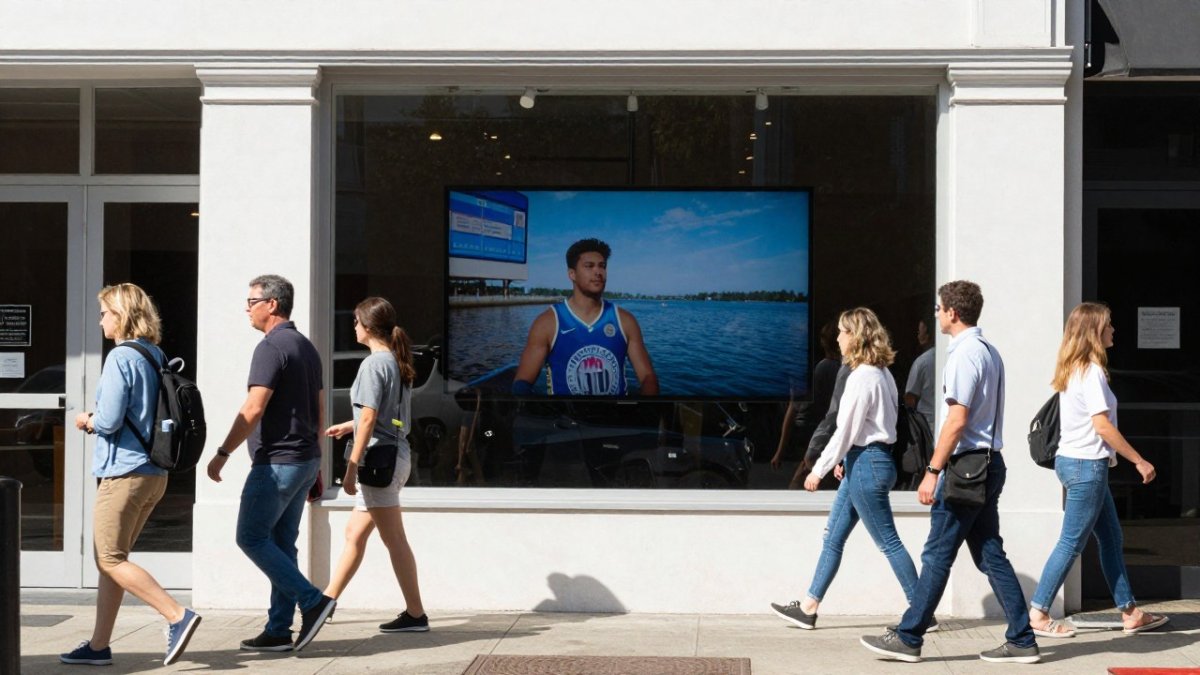
Direct-view LED walls are generally better suited to storefront placement because they can produce enough light to stay readable against daylight. LCD walls can work well inside a store away from direct sun, but they often struggle when placed at the window. Thermal load also matters. Sunlight through glass adds heat, so the display location needs adequate ventilation regardless of technology.
We recommend a simple check before you commit: stand where a customer would stand on the sidewalk, look at the spot where the wall will sit, and note how much direct sun reaches the screen. If the wall faces the street with no shade, direct-view LED deserves a close look.
Pixel Pitch and Viewing Distance for Shopper Sightlines
Pixel pitch is the distance between the centers of adjacent pixels, and it determines how close a shopper can stand before the image breaks into visible dots. A smaller pitch gives a sharper image at close range but costs more. A larger pitch is fine when shoppers view the wall from across an aisle or down a street.
The right pitch depends on where the average viewer will stand. For a wall that customers approach closely, such as one at the checkout area, a fine pitch makes sense. For a storefront wall seen from the sidewalk, a coarser pitch can deliver the same impact for less money.
Map out sightlines before you choose a pitch. Measure the distance from the most common viewing spot to the wall, and make sure the content you plan to run is legible from that point.
Total Cost of Ownership: Direct-View LED vs LCD Video Walls
Most comparisons stop at the purchase price. That is the wrong number to budget against, because a video wall is a multi-year asset that keeps costing money after it is installed. A fair comparison adds up hardware, installation, power, service, replacement parts, and the cost of downtime over the years you plan to own the wall. The figures below are not quotes, pricing depends on wall size, pixel pitch, mounting work, content software, and service terms, but the structure shows how to build a defensible comparison in U.S. dollars.
The five line items to model
- Hardware. Direct-view LED usually carries a higher purchase price per square foot because each cabinet contains its own diode modules and driver electronics. LCD panels are generally cheaper per square foot upfront. Price both at the same finished wall size, not at the panel size, because LED cabinets and LCD panels tile differently.
- Installation. LED cabinets are heavier per square foot and need a mounting structure engineered for the load, plus more cabling between cabinets. LCD walls need a precision mounting grid so the bezels line up. Ask each vendor for a line-item install quote that separates structure, electrical, cabling, and commissioning, so you can compare like with like.
- Power. Multiply the display's rated power draw by your daily operating hours and your electricity rate. The honest comparison is power draw at the brightness you will actually run. A storefront wall running at high brightness all day can erase an efficiency advantage that only shows up at low brightness.
- Service and replacement parts. LED cabinets are modular, so a failed module or cabinet can often be swapped without replacing the whole wall. LCD walls can also be serviced panel by panel, but a single panel swap may require opening the frame and bezel, which adds labor. Ask for the service rate, the response-time commitment, and the price of a spare cabinet or panel, and whether spares are stocked or built to order.
- Downtime. This is the line item most spreadsheets miss. A dark wall in a storefront is lost merchandising time. Estimate the hours a wall would be down per year under each service model, multiply by a conservative value per hour of lost display time, and add it to the total. A cheaper wall with slow parts availability can lose on this line alone.
How to build the comparison
Set a common ownership period, five years is a common planning horizon, and a common wall size and brightness target. Then fill in each line item from at least two vendor quotes. Divide the five-year total by the number of months to get a monthly cost of ownership, which is the number a store budget can actually absorb. A wall that costs more on day one but needs fewer service visits and less power can come out ahead on a monthly basis; a wall that wins on purchase price can lose once downtime and parts are counted.
Watch out: vendors often quote hardware and installation together and omit service and spares, which makes the cheaper option look cheaper than it is. Insist on a quote that separates all five line items before you compare totals.
ENERGY STAR commercial display specifications
Video Wall Maintenance, Lifespan, and Installation Logistics
A video wall is only profitable if it stays on and the store stays open.
Plan the install around store operations
Retail installs are usually compressed into a window, overnight, before opening, or during a slow season, because a closed sales floor costs money. Infrastructure such as certified copper and fiber cabling, racks and patching is often installed in the same window.
Access, structure, and power
A large LED wall is heavy, and the mounting structure has to carry that load safely.
Service access after the wall goes live
Ask how the wall will be serviced before you sign. Front-serviceable LED cabinets can usually be reached from the front without removing the entire display, which shortens repair visits and lets technicians work during store hours.
Lifespan and recalibration
Both technologies dim over time, and the panels or cabinets in a wall can drift apart in color and brightness. A wall that looked uniform at installation can show visible patches years later.
Watch out: a service agreement that covers parts but not recalibration can leave you with a working wall that no longer looks uniform, so confirm both are included.
Choosing the Right Display for Your Store: Next Steps
The right choice comes down to three questions: where the wall sits, how far shoppers stand from it, and what the total cost looks like over the life of the display. If the wall faces a bright window and must draw attention from the street, direct-view LED is usually the stronger fit. If the wall sits indoors on a tighter budget, LCD can deliver good results.
Before you buy, compare the two technologies against your own sightlines and light conditions. Then request a written, site-specific quote from an installer. Dalcorp Solutions Inc provides low-voltage, security, and networking infrastructure services in the Chicagoland area, including LED video walls, and can survey your store, measure the viewing conditions and recommend a pixel pitch and mounting plan.
Frequently Asked Questions
Which is better for a retail video wall, LED or LCD?
Direct-view LED generally suits large, bright, or seamless installations such as storefront windows and feature walls, because its panels lock together without visible borders and hold brightness in daylight. LCD video walls usually have a lower initial cost and produce sharp images at closer viewing distances, which fits interior back-of-store or aisle displays with moderate brightness needs. The right choice depends on where the wall sits, how far shoppers stand from it, and how much ambient light the space receives.
How much does a direct-view LED video wall cost compared with LCD for a retail store?
Pricing depends on screen size, pixel pitch, installation structure, quantity, and delivery, so no single figure applies to every store. LCD walls typically have a lower initial cost, while direct-view LED walls cost more upfront but can offer energy-efficiency and lifespan advantages that affect total cost of ownership. Dalcorp Solutions Inc does not publish standard prices, so request a site-specific quote through the company website to compare options for your store.
What pixel pitch should a retail LED video wall use?
Pixel pitch should match the viewing distance of the shoppers who will read the content. Finer pitches produce sharper images for customers standing close, such as in a checkout area or a small interior feature wall, while coarser pitches suit storefront displays viewed from across a street or parking lot. Measure the typical distance from the closest standing position to the wall before selecting a pitch, and review the content you plan to show, since text-heavy material needs a finer pitch than large promotional graphics.
How long do direct-view LED and LCD video walls last?
Both technologies have finite lifespans, and the figures vary by manufacturer, usage hours, operating temperature, and maintenance. Direct-view LED walls are often described as having longer rated lifespans and better energy efficiency than LCD walls, while LCD walls depend on backlighting that can dim over time. Ask any supplier for rated lifetime figures in writing, confirm front serviceability for module replacement, and plan for recalibration to keep color consistent across the full display.

- Hits: 6