Licensed Low Voltage Contractors in Chicago: 2026 Guide
Hiring licensed low voltage contractors in Chicago is the difference between a network that quietly runs for a decade and one that fails an inspection, drops calls during peak hours, or leaves your building with code violations you didn't know existed. At Dalcorp Solutions Inc, we've spent more than 25 years installing and supporting these systems across Chicagoland, and the scope is broader than most property owners expect.
Table of Contents
- What Licensed Low Voltage Contractors in Chicago Actually Do
- Low Voltage Contractor Licensing Requirements in Chicago
- Low Voltage Technician Certifications That Matter
- Commercial Network Cabling Installation: What the Project Involves
- Cat 6 Cabling: When It Makes Sense for Your Building
- What Drives Cost When Hiring Low Voltage Contractors in Chicago
- Choosing the Right Contractor for Your Project
- Frequently Asked Questions
Last Updated: October 6, 2026
What Licensed Low Voltage Contractors in Chicago Actually Do
Low-voltage systems are building infrastructure that operates at limited power levels, typically for data, communications, and security rather than primary electrical distribution. That distinction matters because it determines which trades, permits, and qualifications apply to your project.
Core Service Categories for Commercial and Residential Properties
The work splits into a handful of recognizable categories. On the commercial side, that means structured cabling, network cabling, access control, video surveillance, Wi-Fi deployment, and audio-visual systems. Residential projects lean toward integrated home networks, smart security, and whole-home Wi-Fi coverage. Many firms handle both, but the qualifications and project scale differ sharply between a single-family home and a multi-tenant office building.
Low Voltage Contractor Licensing Requirements in Chicago
Most guides stop at "hire a licensed contractor." That advice is useless until you know which license, issued by whom, actually covers the work in your building.
Here is the practical breakdown of who regulates what.
City electrical contractor license. The City of Chicago Department of Buildings issues electrical contractor licenses and regulates electrical work inside city limits.
State electrical licenses. The Illinois Department of Financial and Professional Regulation administers state-level electrical licensing.
Fire alarm and life-safety work. Fire alarm installation, modification, and monitoring are regulated separately from general low-voltage cabling.
Permits. Not every low-voltage job needs one.
Inspection. Where a permit is issued, an inspection usually follows. The inspector is checking code compliance, firestopping at penetrations, and in some cases the labeling and test documentation.
How to Verify a Contractor's License, Insurance, and Qualifications
Verification is straightforward if you know where to look. Work through this list before you sign anything.
- Request the contractor's license number and confirm it directly with the issuing authority, not with a photocopy the contractor provides
- Confirm the license type matches your scope (general electrical vs. fire alarm vs. low-voltage cabling)
- Ask for a certificate of insurance showing general liability and workers' compensation coverage
- Call the insurance carrier to confirm the policy is current and the limits are adequate for your project
- Check whether the firm is factory-certified for the specific systems it will install
- Request references from projects comparable to yours in size and building type
- Confirm in writing who pulls the permit, who pays for it, and who schedules the inspection
- Get the scope, testing standard, and closeout deliverables in the contract before mobilization
An insured contractor protects you from liability if a worker is injured on site or property is damaged. Skipping this step is the single most common mistake we see property managers make.
Low Voltage Technician Certifications That Matter
Certifications tell you whether the people pulling your cable were trained to a recognized standard. Low voltage technician certifications include manufacturer credentials for specific systems, industry certifications covering structured cabling and network design, and formal apprenticeship or training program completion. A union contractor typically brings technicians through a structured apprenticeship, while a non-union pathway may rely on manufacturer training and on-the-job experience.
What matters most is relevance. A certification in fire alarm systems says little about someone's ability to terminate and test Cat 6 cabling to specification. Match credentials to the actual work.
Commercial Network Cabling Installation: What the Project Involves
A commercial network cabling installation moves through a predictable sequence: site survey, design, cabling, termination, testing, labeling, and documentation. The survey confirms pathways, distances, and power needs.
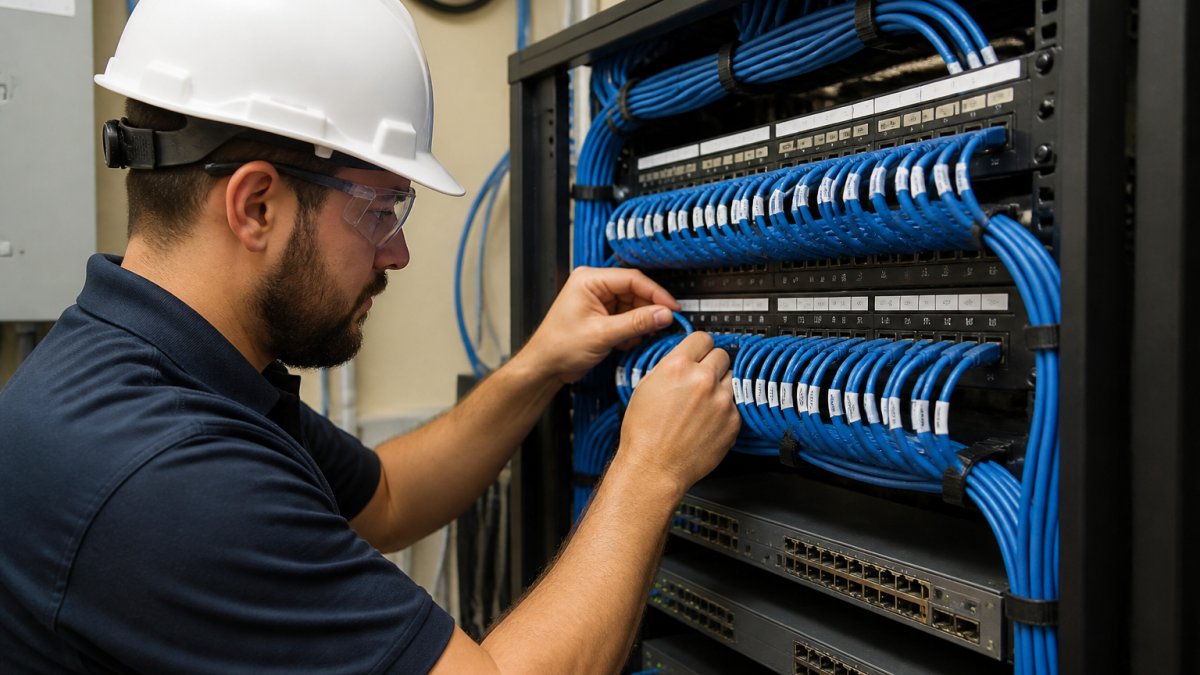
Testing is where cheap installations reveal themselves. Every run should be certified to the applicable standard, and you should receive the test results. If a contractor can't produce them, the installation was never verified.
IDF Refresh and Structured Cabling Scope
An IDF refresh replaces aging cabling, patch panels, and cabinets in an intermediate distribution frame to restore performance and organization. Structured cabling is the standardized physical infrastructure that supports voice, data, and video across a building. A refresh is often the right call when a building's cabling predates current bandwidth needs or when years of ad-hoc changes have left the closet unmanageable.
Cat 6 Cabling: When It Makes Sense for Your Building
Cat 6 cabling is the practical default for most commercial deployments today, offering higher bandwidth and better noise resistance than older cable categories. It makes sense when you're building out new space, refreshing an aging IDF, or supporting devices that need more throughput than legacy cabling reliably delivers.
Where it doesn't make sense: retrofitting an entire building when only a few runs are underperforming. Targeted upgrades often solve the problem at a fraction of the disruption.
| Situation | Recommended Approach | Why |
|---|---|---|
| New construction or major renovation | Full Cat 6 deployment | Lowest cost point to install once |
| Aging IDF, frequent faults | IDF refresh with Cat 6 | Restores reliability and organization |
| A few slow runs only | Targeted replacement | Avoids unnecessary disruption |
| Bandwidth-heavy devices | Cat 6 to those endpoints | Matches cable to demand |
What Drives Cost When Hiring Low Voltage Contractors in Chicago
No honest contractor publishes a flat rate for low-voltage work, because the variables move the number by multiples, not percentages.
Cable type and quantity. The cable itself is usually the smallest line item.
Pathway difficulty. This is where estimates diverge most. Open ceiling with accessible cable tray is fast.
Terminations and testing. Every run has two ends.
Permits and inspection. Where a permit is required, the fee and the inspection time are real costs.
After-hours and occupied-space work. If the building cannot be shut down during business hours, the work moves to nights and weekends.
Documentation and closeout. As-built drawings, labeling schedules, and test reports take time.
How to Compare Proposals Without a Flat Rate
Since no two projects are identical, compare proposals on scope rather than on the bottom line alone.
| Cost Driver | What to Look For in the Proposal | Why It Matters |
|---|---|---|
| Cable type and count | Explicit category, shielding, and run count | Determines performance ceiling and material cost |
| Pathway and access | Assumptions about ceiling type and access | The largest source of estimate variance |
| Firestopping | Named materials and inspection responsibility | Code compliance and inspection pass |
| Testing and certification | Named standard and deliverable test reports | Separates verified work from unverified work |
| Permits | Who pulls, who pays, who schedules inspection | Avoids surprise fees and delays |
| After-hours premium | Stated rate or multiplier | Prevents buried labor cost |
| Closeout documents | As-builts, labeling, warranty terms | Protects you after the crew leaves |
A common pattern is that the lowest bid omits testing, documentation, and firestopping, then adds them back as change orders. The second-lowest bid, with everything included, is often the cheaper project.
Choosing the Right Contractor for Your Project
Selection comes down to verified qualifications, relevant experience, and a clear process. A contractor who is licensed, insured, factory-certified, and willing to document the work is worth more than a lower quote from a firm that can't answer basic licensing questions.
At Dalcorp Solutions Inc, we handle residential, commercial, and multi-property projects across Chicagoland, from a single home network to multi-building access control and video surveillance deployments. Our team is licensed and insured, factory-certified, and code-aware from the first site survey through ongoing support.
Frequently Asked Questions
Is low voltage work considered electrical work in Illinois?
Low voltage work covers systems that operate below 50 volts, including network cabling, security cameras, access control, and fire alarms. Illinois treats this as a distinct trade from standard electrical work. That means a licensed electrician is not automatically qualified for low voltage installation, and a low voltage contractor is not authorized to run line-voltage circuits. Always confirm the contractor holds credentials matching your specific project scope.
What certifications should a low voltage technician have?
Industry-recognized credentials include BICSI Installer or Technician certification, CompTIA Network+ for networking fundamentals, and manufacturer-specific training from brands like Axis, Bosch, or Honeywell. For structured cabling projects, BICSI RCDD or Installer 2 Copper credentials signal competence in Cat 6 cabling and fiber termination. Ask for proof of current certifications, not expired ones, and verify they align with the systems being installed.
What should I verify before hiring a low voltage contractor in Chicago?
Check four things: a current city or state license for low voltage work, a certificate of insurance showing general liability and workers' compensation coverage, at least three references from comparable projects in the past two years, and written scope documentation that lists cable types, termination standards, and testing procedures. Request a certificate of insurance directly from the insurer, not a photocopy from the contractor, to confirm active coverage.
How do I choose a contractor for commercial network cabling installation?
Start with the scope: how many drops, what cable category, and whether the project includes an IDF refresh. Then compare contractors on three factors: documented experience with similar building types, testing and certification practices (Fluke test results for every run), and warranty terms. A contractor who provides as-built documentation, labels every cable, and offers a multi-year workmanship warranty is worth more than the lowest bid.
What services do low voltage contractors provide?
Typical services include structured cabling (Cat 6, Cat 6A, fiber), network switch and router installation, wireless access point deployment, video surveillance, access control, fire alarm systems, audio-visual and LED video walls, and intercom or paging systems. Many contractors also handle IDF room buildouts, cable management, and ongoing maintenance. For commercial properties, the scope often includes integration between security, networking, and building management systems.
What should a low voltage cabling installation include?
A complete installation includes a site survey, cable pathway design, pull and termination, labeling on both ends, and performance testing with documented results. For Cat 6 cabling, every run should pass a Fluke or equivalent certification test. The contractor should also provide as-built drawings, a patch panel schedule, and a warranty covering both materials and workmanship. Missing any of these items creates problems during future moves, adds, or troubleshooting.
How much do low voltage contractors charge per hour in Chicago?
Pricing depends on quantity, site conditions, and delivery timeline. For an accurate figure, request a written quote that breaks out labor, materials, testing, and documentation. Avoid contractors who quote a single lump sum without itemizing scope, as change orders become difficult to manage.
Can you do electrical work in Illinois without a license?
No. Illinois requires licensure for electrical work, and many municipalities including Chicago enforce additional local licensing. Low voltage work falls under separate credentials, but it still requires authorization. Performing unlicensed work exposes property owners to failed inspections, insurance claim denials, and liability if an incident occurs. Always verify credentials through the issuing authority before signing a contract.
The challenge with low-voltage infrastructure is that problems stay invisible until something fails, and by then the cost of fixing it has grown. Dalcorp Solutions Inc designs, installs, and supports integrated systems including Wi-Fi, access control, video surveillance, and LED video walls, backed by 25+ years in Chicagoland and a clear process from survey to support. Get started with Dalcorp Solutions Inc and build infrastructure that performs for the long term.
- Hits: 6