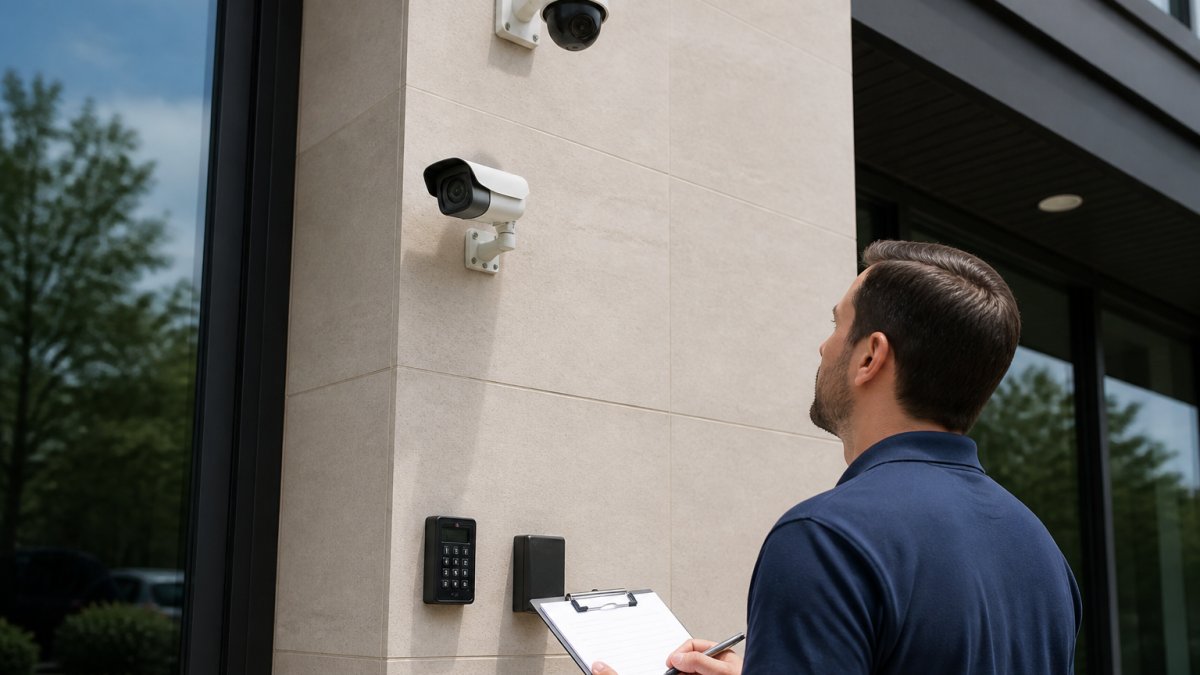
7 Benefits of Professional Security Site Surveys
Professional security site surveys are documented, on-site assessments of a facility's physical security posture, covering entry points, surveillance coverage, lighting, perimeter conditions, and life-safety systems. They deliver a written record of ranked vulnerabilities and prioritized recommendations you can hand to an insurer, code official, or facilities team.
Last Updated: October 25, 2026
Quick Summary
- A documented survey records conditions with photos, ties each finding to a risk level, and ends with prioritized recommendations.
- Access control assessments map every door, gate, and opening, then test whether each actually controls who passes through.
- Blind spot mapping overlays camera positions on a floor plan and marks areas with no, partial, or failing night coverage.
- Most facilities benefit from a full survey annually, with a lighter review after any renovation, tenant change, or incident.
- Each report item should carry an owner, target date, and estimated cost range, with follow-up review 30 to 90 days after remediation.
Table of Contents
- What a Professional Security Site Survey Actually Delivers
- Benefit 1: Risk Identification From a Criminal Perspective
- Benefit 2: An Access Control Assessment That Finds Weak Entry Points
- Benefit 3: Surveillance Coverage Review and Blind Spot Mapping
- Benefit 4: Perimeter, Lighting, and Communication System Evaluation
- Benefit 5: Code, Insurance, and Compliance Evidence
- Your Security Survey Checklist: What the Inspector Should Cover
- From Findings to Action: The Security Assessment Report
- Frequently Asked Questions
What a Professional Security Site Survey Actually Delivers
Professional security site surveys are documented, on-site assessments of a facility's physical security posture, covering entry points, surveillance coverage, lighting, perimeter conditions, and life-safety systems. We treat security site surveys as evidence-gathering exercises, not sales visits.
That distinction matters more than most building owners expect. A survey produces findings you can act on and defend. A walkthrough produces opinions you forget by Friday.
The Difference Between a Walkthrough and a Documented Survey
A walkthrough is informal: someone with experience walks the property, points at problems, and leaves. A documented survey follows a repeatable method, records conditions with photos and notes, ties each finding to a risk level, and ends with prioritized security recommendations.
The gap shows up later. When an insurer asks how you identified a weak entry point, only one of those two approaches gives you an answer.
Benefit 1: Risk Identification From a Criminal Perspective
The most valuable habit in a security survey is thinking like the person you're trying to stop.
That criminal perspective surfaces things routine inspections miss. A loading dock propped open for airflow. A rear stairwell door with a crash bar that no longer latches.
A common mistake is treating risk identification as a checklist of equipment. The real output is a ranked list of vulnerabilities, each tied to a plausible threat and a concrete fix.
Benefit 2: An Access Control Assessment That Finds Weak Entry Points
An access control assessment maps every door, gate, and opening on a property, then tests whether each one actually controls who passes through. Most facilities fail on the doors nobody thinks about: service corridors, roof access, and shared tenant entries.
Weak entry points tend to share a few traits:
- Credentials shared among staff or never deactivated after turnover
- Doors that fail open during a power interruption instead of failing secure
- Visitor traffic routed through an uncontrolled lobby or mailroom
- Alarm systems that report intrusions but don't prevent them
Access control systems work starts with this assessment because a lock schedule built on bad assumptions just automates the wrong policy.
Benefit 3: Surveillance Coverage Review and Blind Spot Mapping
Camera coverage gets reviewed by walking the recorded field of view, not by counting cameras. A facility can have dozens of units and still miss the one corridor where incidents actually happen.
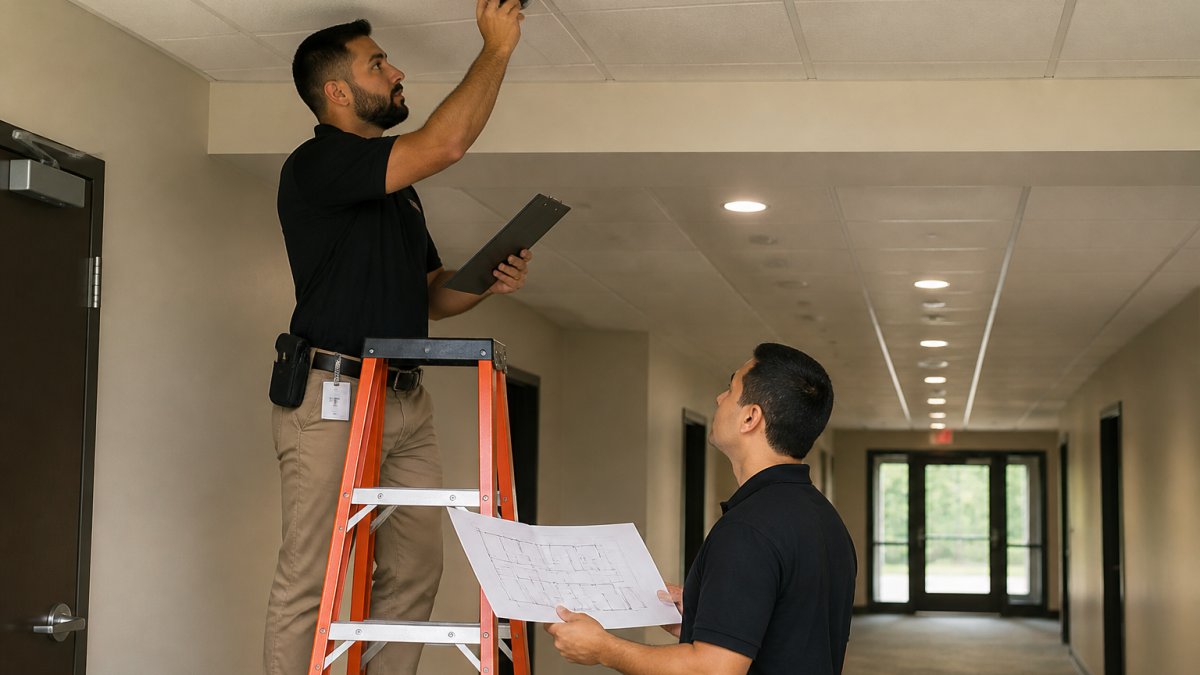
Blind spot mapping means overlaying camera positions on a floor plan and marking every area with no coverage, partial coverage, or coverage that fails at night.
Most survey reports stop at "add a camera here." That is the shallow version of this benefit. A professional survey also grades the system behind the camera, because coverage you cannot retrieve, identify, or export is coverage you cannot use. The assessment should score each of the following, camera by camera and recorder by recorder:
- Image quality and pixel density. Practitioners commonly judge identification by pixels on target rather than by camera megapixel rating. A wide-angle 4K unit covering a 60-foot loading apron may put fewer pixels on a face than a 1080p unit zoomed to the door. The survey should note, for each critical point, whether the recorded image supports recognition of a face, a license plate, or a badge.
- Field of view versus purpose. Entrances, cash-handling areas, and vehicle gates need tighter views; open lots need overview coverage. A camera doing both jobs usually does neither well.
- Lighting and low-light performance. Confirm whether each camera is fixed-lens day/night, has integrated IR, or depends on site lighting. Then check that the lighting plan and the camera settings agree, since a lighting upgrade can wash out an image if exposure and contrast are never retuned.
- Recording, storage, and retention. Verify the recorder's channel count, the configured frame rate and resolution per channel, and the actual retention days at that load. A system advertised at 30 days often delivers far less once every channel runs at full resolution. Retention should match the facility's incident-discovery window and any contractual or insurance requirement.
- Network and power. Confirm whether cameras are PoE or locally powered, the switch port budget and uplink capacity, and whether the surveillance VLAN is segmented from business traffic. A camera that drops offline during a network event is a blind spot with a status light.
When planning video surveillance, the goal is coverage that supports investigation: can you identify a face, a vehicle, or a badge at the point that matters, and can you produce that footage on request?
Benefit 4: Perimeter, Lighting, and Communication System Evaluation
Perimeter security, lighting, and communication systems fail together more often than owners realize. A fence line is only as good as the lighting that lets a camera see it, and a camera is only as good as the network that carries its signal.
The evaluation covers four fronts:
- Perimeter, fence condition, gate hardware, vehicle barriers, and clear zones
- Lighting, illumination levels at entries, parking areas, and along building faces
- Communication systems, intercoms, mass notification, and radio coverage for staff
- Alarm systems, sensor placement, monitoring response, and false-alarm history
Watch out: lighting upgrades are frequently approved without checking whether existing cameras can handle the change in contrast. A brighter lot can wash out an image if the camera settings are never adjusted.
Benefit 5: Code, Insurance, and Compliance Evidence
A documented survey produces something a walkthrough never does: evidence.
Insurance requirements work the same way. Carriers that write commercial property policies often condition coverage on documented security controls, and a survey report is the artifact that proves them.
Compliance evidence also protects you during a claims dispute. For a deeper look at the wiring and inspection side, see our guide to code compliant wiring.
Your Security Survey Checklist: What the Inspector Should Cover
Use this checklist to evaluate any survey proposal, or to brief your own team before an assessment. A credible survey covers all ten items and documents each one.
- Site inspection of every exterior elevation, not just the main entrance
- Entry point inventory with door hardware and locking condition noted
- Access control review, including credential lifecycle and fail-safe behavior
- Camera coverage mapped against a floor plan, with blind spots marked
- Lighting measurements at entries, lots, and perimeter zones
- Alarm system test, including monitoring response verification
How often should a business conduct a security site survey? Most facilities benefit from a full survey annually, with a lighter review after any renovation, tenant change, or incident. High-traffic retail and multi-tenant properties often need quarterly checks on entry points and camera coverage.
From Findings to Action: The Security Assessment Report
A security assessment report is the survey's final deliverable: a written document listing each finding, its risk level, the recommended fix, and a suggested sequence.
Risk prioritization is where most reports earn their keep. Findings are ranked by likelihood and impact, separating quick fixes from capital projects. A non-latching rear door is a same-week repair.
That sequencing connects directly to how security and networking infrastructure work together. Our article on the benefits of integrated security and networking explains why the two should be planned as one system.
A Likelihood-and-Impact Framework You Can Apply
A ranking is only useful if two people reading the report would rank the same finding the same way. The survey should define its scale up front and apply it consistently:
- Likelihood, how probable is exploitation given the current control? Rate it Low (requires unusual access or effort), Medium (opportunistic, plausible within a year), or High (routine, already occurring or trivially exploitable).
- Impact, what happens if it is exploited? Rate it Low (minor disruption or property loss), Medium (operational interruption, theft, or a reportable incident), or High (injury, major loss, regulatory exposure, or extended closure).
Cross the two and you get a severity band: High likelihood plus High impact is an immediate priority; Low likelihood plus Low impact is monitor-and-review. The report should state the band for every finding and show the reasoning in one or two sentences, so the ranking survives scrutiny from a CFO, an insurer, or a code official.
From Severity to a Phased Plan
Severity tells you what matters; phasing tells you what to do Monday. A practical report groups findings into three tracks:
- Immediate (days to weeks), low-cost, high-severity fixes: re-latching a door, removing concealment near a window, correcting a camera aim, deactivating stale credentials.
- Near-term (one to two budget cycles), targeted upgrades: adding coverage at a mapped blind spot, replacing failed hardware, segmenting the surveillance network, tightening visitor flow.
- Capital (annual planning), platform replacements and major construction: access control migration, perimeter hardening, lighting redesign.
Each item should carry an owner, a target date, and an estimated cost range so the plan can be funded rather than admired. Where a fix depends on another (a new camera needs a switch port and a retention review), the report should note the dependency.
Verification: Proving the Risk Actually Dropped
Implementation is not the end of the engagement. The report should specify how each corrective action will be verified: a re-inspection of the repaired door, a test export from the recorder, a credential audit after deactivation, a monitoring test after an alarm change. Schedule a follow-up review, commonly 30 to 90 days after remediation, to confirm the fix holds and to catch drift.
When you're ready to act on a report, tell us about your site and goals and we'll scope the work.
Frequently Asked Questions
What is a professional security site survey?
A security site survey is an on-site inspection of a property conducted by a qualified security professional to identify vulnerabilities, evaluate existing systems, and recommend improvements. It covers entry points, access control, camera coverage, lighting, perimeter conditions, alarm and communication systems, and how well current equipment matches the building's actual use. The output is a written security assessment report with prioritized recommendations, not a verbal opinion. For facilities in the Chicagoland area, a survey also flags code and insurance compliance gaps.
How often should a business conduct a security site survey?
Most commercial properties should schedule a full security site survey every 12 to 24 months. Move that up to annually, or after any incident, if you handle regulated data, operate in healthcare or education, or manage multi-tenant buildings. Trigger an off-cycle survey after a remodel, a change in tenant mix, a break-in attempt, or a major technology upgrade. A security survey checklist reviewed on a quarterly basis between full surveys keeps small issues from becoming expensive ones.
What should a security assessment report include?
A usable security assessment report should document each finding with a location, a photo or diagram, and a risk rating so you can prioritize spending. Look for a summary of identified vulnerabilities, an access control assessment, camera coverage and blind spot notes, lighting and perimeter observations, and a prioritized list of security recommendations with rough cost ranges. It should also note compliance issues tied to building codes, NFPA 80 for fire door assemblies, and any insurance requirements that affect your coverage.
Can a security site survey help improve access control and video surveillance?
Yes. A survey tests whether credentials are actually enforced at every entry point, whether doors prop open, and whether camera coverage reaches the spots that matter, such as loading docks and cash handling areas. It maps blind spots against real traffic patterns instead of relying on a camera count. The result is a targeted upgrade plan: which readers, locks, and cameras to replace first, and which existing equipment can stay. That prevents paying for new hardware that does not fix the underlying vulnerability.

- Hits: 9