Hiring Licensed Security System Installers in 2026
Hiring licensed security system installers in 2026 means verifying a state-required license, active insurance, and bonding before you sign, because unpermitted wiring can void an insurance claim or fail a fire marshal inspection. Look up the license number directly on your state's licensing board registry and confirm the expiration date, not just the number.
Last Updated: October 23, 2026
Quick Summary
- Verification takes about fifteen minutes and protects a multi-year investment.
- New York requires security and fire alarm installers to hold a state license, with licensure terms running two years.
- Most commercial projects combine alarm, cameras, access control, and fire alarm systems.
- Pay is usually quoted hourly for installers, with salary ranges reserved for senior technicians and project managers.
- Name the specific systems and certifications in a job listing to attract stronger technicians.
Table of Contents
- Why Hiring Licensed Security System Installers Matters in 2026
- How to Verify a Security Contractor License Before You Sign
- The Commercial Security Installation Checklist for 2026 Projects
- What to Look for in a Security System Installation Contract
- Security System Installation Cost: What Drives the Number
- Job Openings, Pay, and Employment Types for Installers in 2026
- Screening Installers: Credentials, Experience, and Specializations
- Frequently Asked Questions
Why Hiring Licensed Security System Installers Matters in 2026
Hiring licensed security system installers in 2026 is the difference between a system that works and one that fails an inspection.
Here is the tension most buyers miss. A cheap installer saves money on the invoice and costs far more later.
Below, we break down how to verify a license, what a contract should say, what drives cost, and where the installer jobs and pay stand in 2026.
How to Verify a Security Contractor License Before You Sign
Verification takes about fifteen minutes and protects a multi-year investment. Start with your state's licensing board, not the contractor's own website. Ask for the license number, then look it up directly on the official registry.
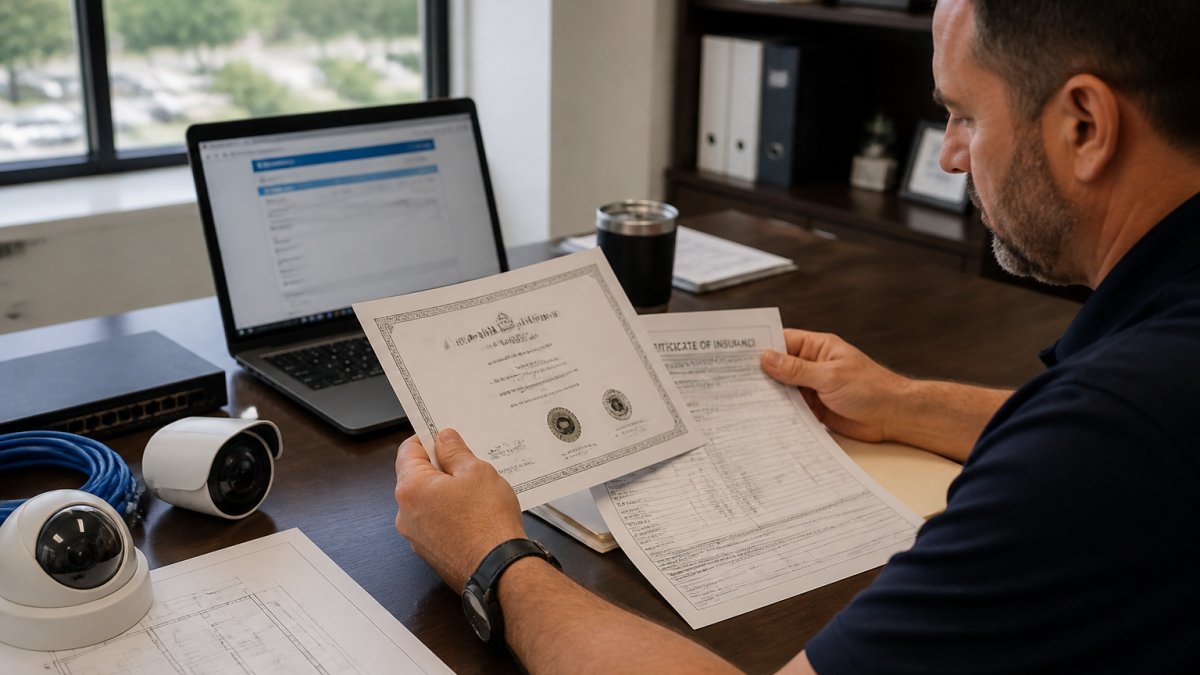
Most states publish a searchable database of licensed alarm and security contractors. For a deeper walkthrough of licensing requirements and how to verify a contractor's credentials, see our guide to licensed low voltage contractors in Chicago.
What a State-Required License Actually Covers
A state-required license confirms the contractor met minimum training, passed a background check, and carries the insurance your jurisdiction demands. It also gives you a regulator to call when something goes wrong. Coverage varies by state, so confirm the specific scope for alarm, access control, and fire alarm work where your building sits.
Insurance, Bonding, and Background Checks
Ask for a certificate of insurance and call the insurer to confirm it is active. A general liability policy protects you if a technician damages the building. A surety bond protects you if the contractor walks off the job. Background checks matter for anyone who will hold keys or access codes to your property.
The Commercial Security Installation Checklist for 2026 Projects
A commercial security installation checklist keeps a project from drifting. Use this one to compare bids and to brief your own team before work starts. To compare vetted providers before committing to a project, see our roundup of the best commercial security system installation services.
- Site survey completed and documented
- System types specified: alarm, camera, access control, fire alarm
- Wiring and low-voltage pathways mapped
System Types: Alarm, Camera, Access Control, and Fire Alarm
Most commercial projects combine four systems. An alarm system detects intrusion and triggers alerts. Security cameras and video surveillance cover entries, lots, and cash areas. Access control manages who enters which door and when. You can explore our access control systems offering for Chicago properties. A fire alarm system handles life safety and must meet code.
What to Look for in a Security System Installation Contract
The contract is where a good installation gets protected. Insist on these terms in writing:
- Scope of work with every device and location listed
- Total price and payment schedule tied to milestones
- Warranty length on labor and on hardware
The thing nobody tells you about security contracts is how much hides in the service clause. A robust labor warranty with clear emergency response terms is worth more than a slightly lower bid with no support terms. Read that section first.
Security System Installation Cost: What Drives the Number
Security system installation cost depends on door count, camera count, wiring conditions, and system type, not a flat rate. Older buildings with limited pathways need more labor. Fire alarm work adds code and inspection requirements. For detailed cost breakdowns to benchmark your budget, see our guide to commercial access control installation cost.
Because pricing depends on your site, we do not quote a number sight unseen.
Job Openings, Pay, and Employment Types for Installers in 2026
The installer labor market in 2026 is active but uneven, and the shape of it matters whether you are hiring or being hired. Job-board volume is the easy part to see. A search on Indeed's security systems installer listings surfaces hundreds of openings across major metros, with new postings added weekly. ZipRecruiter shows dozens of security alarm installer roles in a single market, and Glassdoor listings show employer-provided hourly ranges for technician positions.
What the 2026 Hiring Outlook Actually Looks Like
Three forces are shaping installer demand this year. First, the installed base of commercial systems keeps growing as buildings retrofit cameras, access control, and networked panels, so service and installation work expands even when new construction slows. Second, the workforce skews older, and a meaningful share of experienced low-voltage technicians are retiring or moving into project management, which tightens the pool of journeyman-level installers. Third, manufacturers keep adding networked and IP-based product lines, so employers increasingly want installers who can handle both legacy analog wiring and modern IP configuration.
The practical result is a market where entry-level alarm installer roles are plentiful and competitive on pay, while experienced access control and fire alarm technicians are scarce and command premiums. Employers who post a generic "security installer" listing often wait longer than employers who name the specific systems and certifications the role requires.
Pay Mechanics: Hourly, Salary, and What Moves the Number
Pay is usually quoted as an hourly rate for installers and technicians, with salary ranges reserved for senior technicians, lead installers, and project managers. A few mechanics drive where a given offer lands:
- License status. A state-licensed alarm or security contractor can bill for permitted work; an unlicensed helper cannot. Licensed installers are paid for the credential.
- Certification on specific brands. Factory certification on the control panels and access control platforms a company installs shortens troubleshooting and reduces callbacks, and employers pay for it.
- System type. Fire alarm and access control work carries more code and documentation burden than basic intrusion or camera installation, and pay reflects that.
Employment Types and Role Variations
Roles vary widely: security installer, security systems technician, security alarm installer, low-voltage technician, access control specialist, and fire alarm technician. Employment types include full-time, part-time, and contract work, often Monday to Friday with on-call rotation for service. Most postings ask for construction experience, a valid driver's license, and a clean background check, and many require the ability to lift equipment and work at height.
| Role | Typical Employment | Key Requirement | Pay Structure |
|---|---|---|---|
| Security alarm installer | Full-time | State license, driver's license | Hourly rate |
| Security systems technician | Full-time or contract | Certification, experience | Hourly or salary range |
| Low-voltage technician | Full-time | Wiring and cabling experience | Hourly rate |
| Access control specialist | Full-time | Background check, platform certification | Salary range |
| Fire alarm technician | Full-time | State fire alarm license, code knowledge | Hourly rate |
Screening Installers: Credentials, Experience, and Specializations
Screening is where most hiring mistakes happen, because the credentials that matter are easy to claim and harder to verify. The SERP is full of job listings that say "licensed" without explaining what that means in practice. This section does. Screen in three passes: credentials, then experience, then specialization, and verify each pass against a source outside the candidate's own resume.
Credential Distinctions: License, Certification, Bond, and Insurance
These four terms get used interchangeably and should not be. A state or local license is a legal authorization to perform alarm, security, or fire alarm work in a jurisdiction; it is issued by a regulator and can be looked up. An industry certification is a manufacturer or trade-association credential (for example, factory certification on a specific control panel or access control platform) that signals competence on a product line but is not a license. A surety bond is a financial guarantee that protects the customer if the contractor fails to perform. Insurance is liability coverage that protects the property if a technician damages the building or injures someone on site.
A candidate can hold a certification and no license, or a license and no certification on your specific system. Both matter, and they are not substitutes.
How to Verify Each Credential
Verification is a fifteen-minute exercise per candidate, and it is worth every minute.
- License. Ask for the license number and the issuing jurisdiction, then look it up directly on the state or local licensing board's public registry. Confirm the expiration date, the license type, and whether it covers the work you are hiring for (alarm, access control, fire alarm, or low voltage). Do not accept a screenshot; use the registry.
- Certification. Ask for the certification number and the issuing manufacturer or association, then confirm through that organization's credential lookup if one exists. If no lookup exists, ask for the certificate document and call the issuer.
- Bond. Request the bond number and the surety company, then confirm the bond is active and covers the work scope.
- Insurance. Request a certificate of insurance naming your company as certificate holder, then call the insurer to confirm the policy is active and the limits meet your contract requirements.
- Background check. For anyone who will hold keys or access codes, run your own background check rather than relying on the candidate's statement.
Experience and Specialization: Match the Project, Not the Resume
Experience should be judged against your building type and system scope, not against years alone. Ask for references from buildings similar to yours and call them. A common mistake is hiring a residential specialist for a commercial job. Commercial security, access control, and fire alarm work demand different code knowledge, documentation, and coordination with other trades.
Match the specialization to the project:
- Video surveillance for retail, parking, and cash-handling areas.
- Access control for multi-tenant buildings, data rooms, and restricted zones.
- Fire alarm for life-safety compliance, where code knowledge and inspection documentation are non-negotiable.
Screening Questions That Surface Real Depth
A short set of questions separates paper credentials from working knowledge:
- Which state or local license do you hold, and what work scope does it cover?
- Which control panels and access control platforms are you factory-certified on?
- Walk me through a commercial installation you completed end to end, including permitting and inspection.
The answers tell you whether the candidate has actually carried a project through permitting, inspection, and handoff, or only assisted on one.
At Dalcorp Solutions Inc, our team is licensed and insured and factory-certified, with more than 25 years serving Chicagoland properties. We handle the full scope, from site survey to ongoing support, so one accountable partner owns the result.
Frequently Asked Questions
How do I verify a security system installer's license?
Ask for the license number and the name of the issuing state agency, then look up the record directly on that agency's public database. Confirm the license is active, matches the legal business name on the contract, and covers the work you need, such as alarm, access control, or fire alarm installation. Also request a certificate of insurance and a bond letter, and call the insurer to confirm coverage is current. A legitimate security system installer will provide these without delay.
Should a security system installer be insured and bonded?
Yes. General liability insurance protects your property if a crew damages walls, ceilings, or network cabling, and workers' compensation covers injuries on site. A surety bond gives you a claim route if the contractor fails to complete the job or violates licensing rules. Ask for certificates naming your property or company, verify the policy limits, and confirm the bond is still active. Many commercial property managers require these documents before allowing any low-voltage work to begin.
What should a security system installation contract include?
The contract should list the exact equipment and quantities, the scope of work, the project timeline, payment milestones, and the total security system installation cost with any exclusions. Include warranty terms for labor and hardware, the process for change orders, and who pulls permits. Add a clause covering system maintenance and troubleshooting response times after handover. Require the contractor's license number, insurance details, and a signed acceptance test before final payment.
How much does professional security system installation cost?
There is no single figure because security system installation cost depends on building size, the number of cameras and sensors, access control doors, cabling distance, and whether the work happens after hours. Older buildings with limited pathways often need more labor. Ask for a line-item quote that separates equipment, labor, permits, and programming. Dalcorp Solutions provides site-specific pricing after a survey, so request a quote rather than relying on a generic per-camera estimate.
Do security system installers need permits?
Often yes. Many jurisdictions require an electrical or low-voltage permit for alarm, access control, and fire alarm work, and fire alarm systems usually need separate approval and inspection. The installing contractor should pull the permits and schedule inspections as part of the job. Ask who is responsible before work starts, and keep copies of signed-off permits with your installation contract. Unpermitted work can complicate insurance claims and future building inspections.
Hiring licensed security system installers in 2026 comes down to verification and a clear contract. The cheapest bid rarely survives an inspection, and the right partner makes the whole project simpler. Dalcorp Solutions Inc brings licensed, insured, factory-certified installation with code-aware planning and ongoing support for commercial and residential properties. Get started with Dalcorp Solutions Inc and tell us about your site and goals for a fast, clear proposal.

- Hits: 15